
A little about us

Digital experiences for mental health professionals. We design, build, and rank websites exclusively for wellness practices so you can focus on care.
Let’s build something meaningful
A little about us
Digital experiences for mental health professionals. We design, build, and rank websites exclusively for wellness practices so you can focus on care.
Let’s build something meaningful
For private practices
Therapist website design for private practices of every size — from a solo therapist or counsellor to a multi-clinician clinic. Fixed-fee builds start at $290 for a five-page site, $470 for a ten-page practice site with booking and intake, and $620 for a group practice. The price is agreed in writing before we start, with no hourly billing and no surprise invoices.
Written quote within two working days. No payment taken until you approve it.
Every therapist website needs six things before it needs decoration: a clear statement of who you help, your credentials, the problems you work with, your fees, a frictionless way to enquire, and a privacy page that explains what happens to that enquiry. That is the difference between web design for therapists and a generic brochure site.
01
Name the people, the problems and the way you work in the first screen. “A safe space to explore” could describe ten thousand practices.
02
Your professional body, qualification, registration number where you have one, and a link to the public register. No badge wall.
03
Specialisms, formats, session length and what a first session looks like. One page per cluster of problems, not one page per modality.
04
Session fee, cancellation policy, insurance or funding, and whether you hold a reduced-fee place. Put the number where people can find it.
05
A short enquiry form, a booking link or a phone number. One primary action, repeated, rather than five competing calls to action.
06
A privacy notice that covers enquiries, readable type, keyboard access and alt text. These are part of the design, not an afterthought.
Not sure whether yours covers all six? The full FAQ answers the ownership, timeline and privacy questions in more detail.
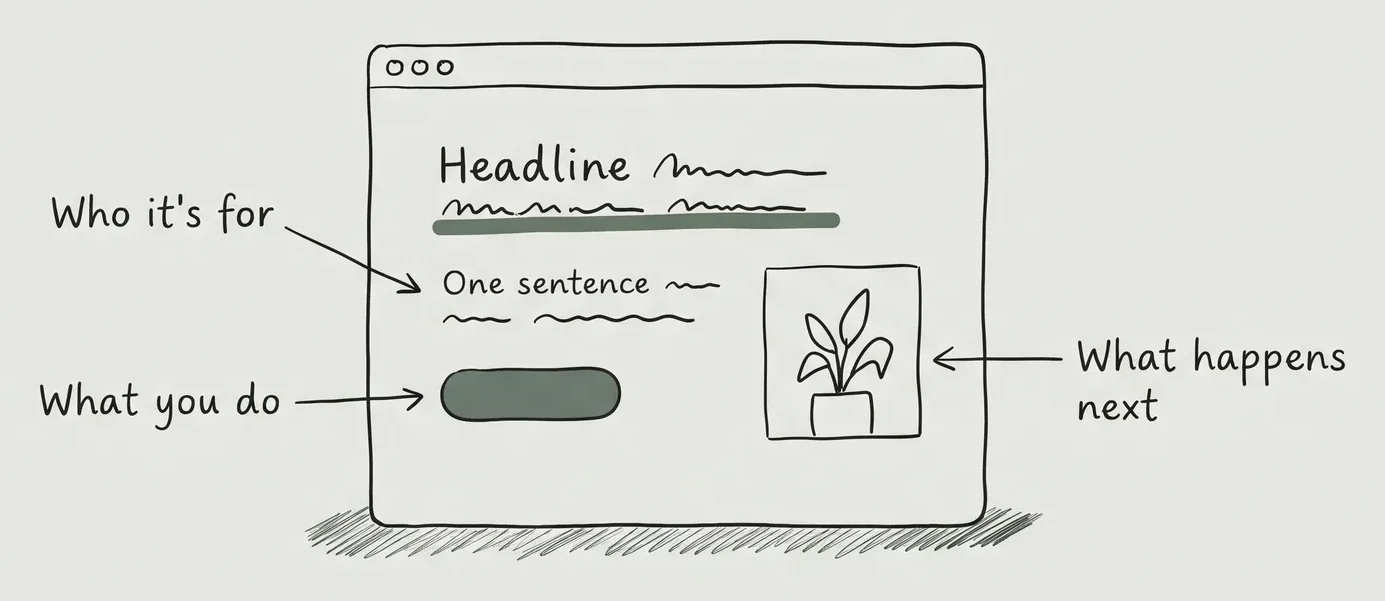
Private practice website design should follow a short, linear path: home, the problems you treat, how you work, about you, fees and contact, with privacy linked from every page. Six pages in that order give people a clear route through the practice; twenty pages with no route do not.
01
One sentence on who you help, one proof of credibility, one action. Everything else can wait.
02
Group the problems you treat into a small number of pages. Each page answers: is this me, and what happens next?
03
How you work, what you believe about therapy, and the credentials that matter. Not a CV in reverse chronological order.
04
The session fee, what it includes, cancellation terms, and any insurance or funding routes. A short page beats a PDF.
05
A form that asks only what you need, a phone number for people who prefer to call, and a clear response time.
06
What happens to an enquiry, who can see it, how long you keep it, and how to ask for it to be deleted. Linked from every page.
Page count
The tier decides the page count; the structure stays the same. You can see exactly what each tier covers on the pricing page.
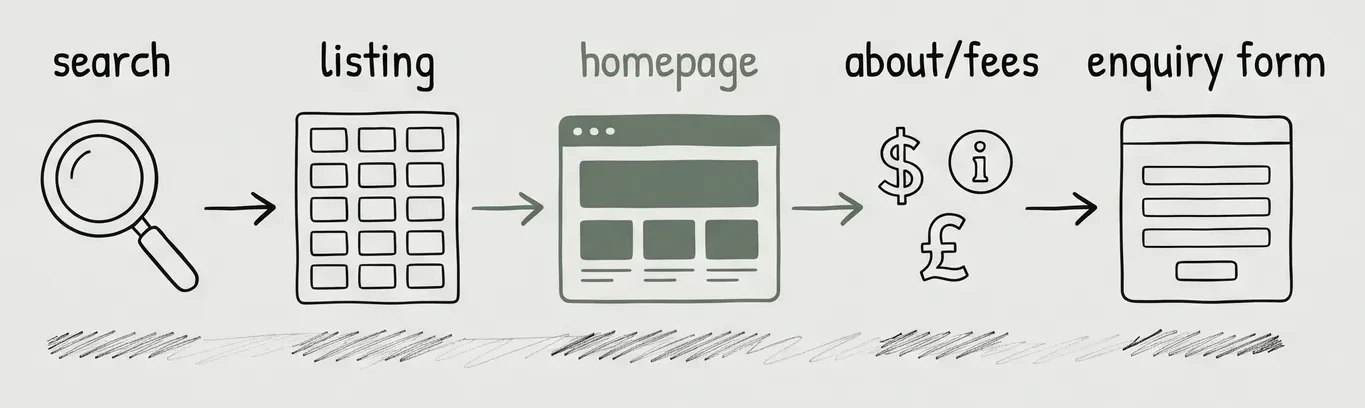
Calm therapy website design is low-effort to read: generous space, one type family, restrained colour, real photography and a single primary action on every screen. Decoration adds visual interest; calm design removes decisions.
01
Wide margins and short line lengths lower the effort of reading when someone is already anxious.
02
A serif for headings and a clean sans for body is enough. More than that reads as noise.
03
One accent for actions, one tint for panels. Never rely on colour alone to carry meaning.
04
Natural light, a real chair, no stock handshake. If you do not have photographs, use illustration rather than fake smiles.
The 11pm test
If the fee and the enquiry button are not visible without pinching, the design is not finished. The same rules apply to website design for counsellors (the UK spelling) and psychotherapists: the vocabulary changes, the structure does not.
For most therapy practices, WordPress with Elementor gives the best balance of ownership, booking integration and SEO control; Squarespace suits a solo practice that wants the simplest possible edit, and Wix sits between the two. The table below compares them on the things that matter to a practice, not on feature lists.
| WordPresswhat we build on | Squarespace | Wix | |
|---|---|---|---|
| Cost model | Build fee plus separate hosting and plugins | One subscription, hosting included | One subscription, hosting included |
| Who owns it | You — domain, hosting, site files and content | You own the domain and content; the site stays on their platform | You own the domain and content; the site stays on their platform |
| Editing difficulty | Moderate — a page builder, with more ways to break a layout | Easy — polished templates, fewer choices | Easy — drag and drop, more layout freedom than Squarespace |
| Booking/forms | Any form or booking plugin; connects to most practice software | Native forms and scheduling; fewer clinical integrations | Native forms and Wix Bookings; an app market for extras |
| SEO control | Full — schema, redirects, robots, page speed and caching | Good basics; limited technical control | Good basics; less control over markup and redirects |
Platform features and fees change; check current pricing before you commit.
We build on WordPress with Elementor because you keep the domain, the hosting account and the files. Booking and practice software can be wired in rather than bolted on. If a solo practice already has a Squarespace site that works and only needs a refresh, we will say so rather than sell a migration.
Questions
Straight answers to the questions that decide a build.
The full FAQ covers privacy, ownership and working with an existing site in more depth.
A five-page Solo site is $290, a ten-page Practice site with booking and intake is $470, and a multi-clinician Group site is $620. Those are fixed build fees in USD; hosting, domain and any practice software are separate and shown before you commit.
Most builds take three to four weeks from the point the content is agreed. A solo site can be quicker; a group site with team pages and integrations usually takes longer. The content, not the design, is normally the long pole.
Yes. The domain is registered in your name, the hosting account is yours, and you get the WordPress site and its content. If you leave, you take the site with you.
No. You can supply it, or we can write it as a separate line item. Copy is quoted separately because the amount of work varies more than the design does.
Yes. If you have a brand you are happy with, we design within it. If it needs work, we will say so before you commission anything.
Yes. We hand over a WordPress build you can edit, with a short walkthrough and a written guide. You do not need to touch code for routine changes.
Where to go next
We build websites for therapists at three fixed prices. Everything below is one click from here, including the cost guide we are writing next.
Pricing
What the Solo, Practice and Group builds include, and what is never charged separately.
Industries
Solo online practices, couples work, trauma services, group clinics and more.
Cost guide
The next page in this series, with the numbers behind each tier.
Your next chapter
Tell us the size of your practice and what you need. A person reads it and replies within two working days, with a fixed quote and anything we need to confirm first.